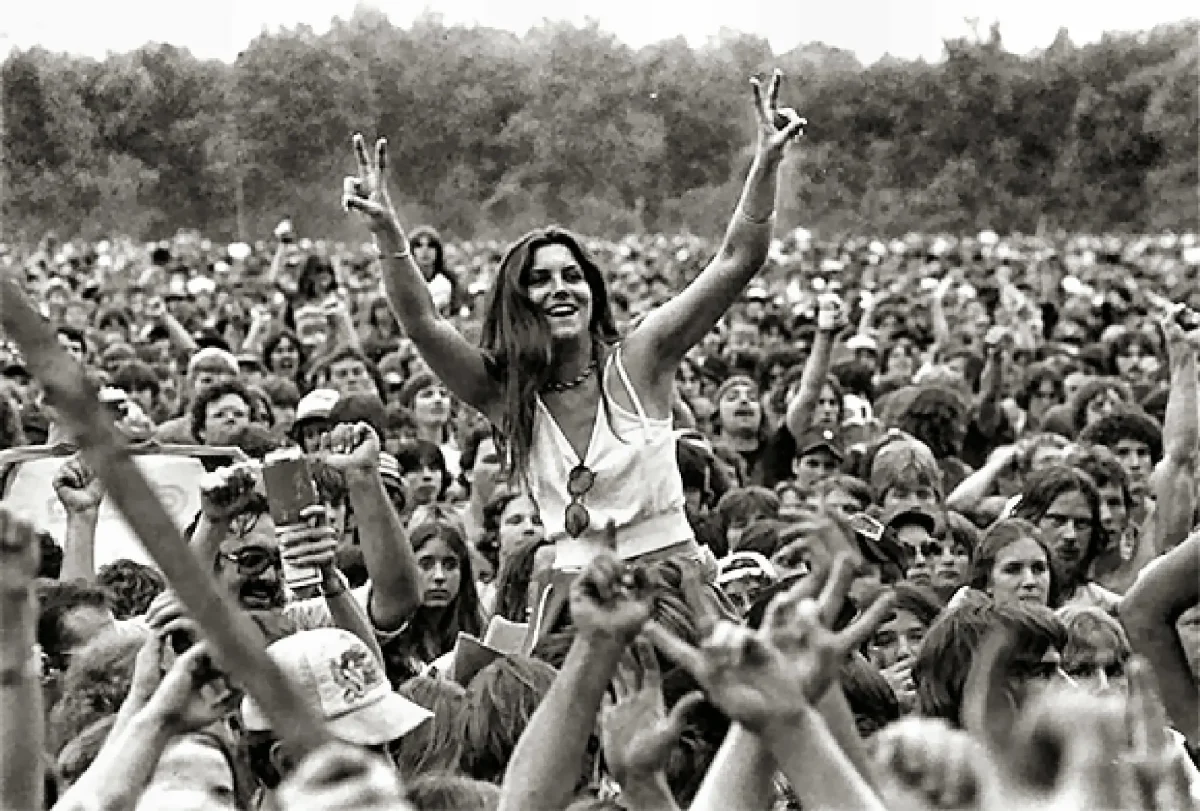
On the weekend of August 15th-18th, 1969 in Bethel, NY musical history was forever changed. With a lineup of 32 acts, Woodstock was known as “3 Days of Peace and Music”. Artists such as Joan Baez, Janis Joplin, Santana, and the legendary Jimi Hendrix played. This new type of festival symbolized peace, unity, freedom, and love and was a turning point in concert history.
There are many reasons why Woodstock 69’ is culturally significant. Woodstock was originally created by people who just wanted to build a music studio in New York. After word got out that a big festival was in the works, local residents wanted it canceled. They were unsuccessful, and 50,000 tickets were sold. However, on the day of the event, over 450,000 people showed up. Artists had to be helicoptered in because the roads were so backed up with traffic. Since everyone was so backed up in traffic, the band Sweetwater was not able to play the first act as planned. Instead, popular artist Richie Havens had to open the festival. Since venue workers were still rushing to set up and accommodate everyone, Havens had to pass time by playing every song he knew by memory whilst the venue workers rushed to set up and accommodate everyone. After numerous encores, he came out one last time where he completely improvised a song called ¨Freedom/Motherless Child¨. Everyone was absolutely blown away. After his incredible performance, Sweetwater was able to come and perform second.
Mid festival, the skies opened up. There were crazy thunderstorms and heavy rain. The event staff was extremely concerned with all of the electrical equipment up on stage. Bob Weir of The Grateful Dead told Rolling Stone magazine during an interview, ¨Every time I touched my instrument, I got a shock. The stage was wet, and the electricity was coming through me. I was conducting! Touching my guitar and the microphone was nearly fatal. There was a great big blue spark about the size of a baseball, and I got lifted off my feet and sent back 8 or 10 feet to my amplifier.¨ The venue/farm got turned into pure mud. However, it became part of the experience. It ended up raining that Friday night, Saturday morning, and Sunday evening. Literally an electrifying rock n’ roll spectacle.
Since Woodstock was in the middle of the Vietnam War, there was a lot of negativity and gloom in the world. Woodstock 1969 was part of the peace movement also known as the era of the hippies. Even security guards at the venue wore a peace sign on their uniforms to symbolize that they were not there to create violence. Some referred to them as the ¨Peace Force¨. Jimi Hendrix was the last artist to perform. He played for over two hours straight to the less than 30,000 people who still remained. His last song was ¨The Star Spangled Banner¨ which really helped capture the harmony and solidarity this festival was trying to create.
Woodstock’s success created a legacy and led to two other Woodstock festivals in the 1990s: Woodstock 94’ and 99’. These festivities were also very famous, but none could hold a candle to the original, but these were filmed and broadcasted by MTV globally. At Woodstock 1994, popular artists like Metallica, Nine Inch Nails, Aerosmith, and the Red Hot Chili Peppers performed. In 1999, Limp Bizkit, Korn, Alanis Morissette, and Kid Rock sang as well as many others. However, this 1999 festival was deemed infamous because of riots, lack of food and water due to overcrowding, and bonfires that got out of hand. Three people died and forty-four were arrested.
Woodstock 1969 went down as one of the largest music festivals of all time. The peaceful nature of the event inspired acts of kindness and sympathy that changed the music culture of the world today.