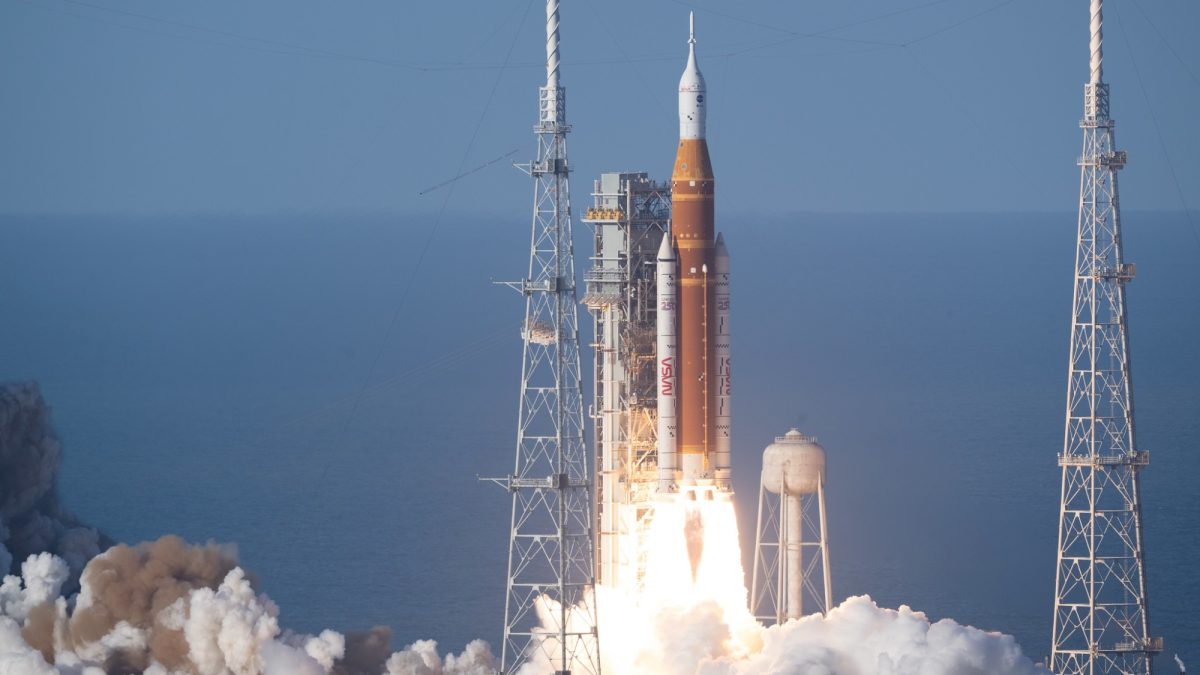
The Artemis II mission is one of the most important space missions in modern history because it represents humanity’s return to deep space after more than 50 years. Launched by NASA on April 1st 2026, Artemis II is the first crewed mission of the Artemis program, and it is a test flight that sends astronauts around the Moon and back to Earth. Unlike earlier missions that focused only on orbiting Earth, this mission travels into what scientists call “cislunar space,” the space between Earth and the Moon. According to NASA, the flight lasts about 10 days and is designed to test critical systems needed for future missions. This includes the powerful Space Launch System rocket and the Orion spacecraft, both of which need to work perfectly to safely carry humans beyond Earth’s orbit. Overall, Artemis II is not just about exploration, it is about proving that humans can once again travel safely into deep space and eventually return to the Moon for long-term missions.
The main goal of Artemis II is to test systems and prepare for future lunar landings, especially the planned Artemis III mission. Instead of landing on the Moon, the crew will perform a “lunar flyby,” meaning they will travel around the Moon and then return to Earth using its gravity. This type of path, called a free-return trajectory, is important because it makes sure the spacecraft can come home even if something goes wrong. During the mission, astronauts will test navigation, communication, and life-support systems, which are all necessary for longer missions in the future. They will also conduct experiments related to human health, radiation exposure, and spacecraft performance. Scientists want to understand how the human body reacts to deep space conditions, which are very different from low Earth orbit conditions. The mission will also gather valuable data to help engineers improve spacecraft design. According to recent reports, Artemis II will carry humans farther from Earth than anyone has traveled since the Apollo missions, making it a major milestone in space exploration.
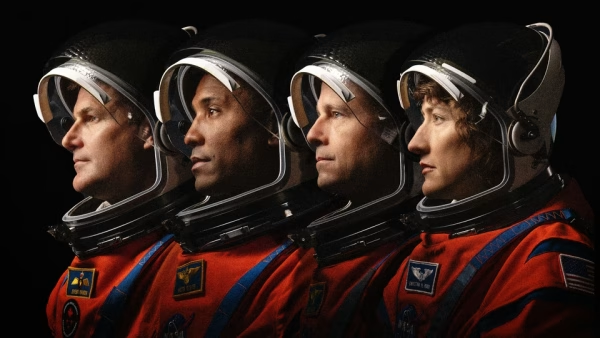
Another important part of Artemis II is its crew, which represents a new era of diversity and international cooperation in space travel. The four astronauts are Reid Wiseman, Victor Glover, Christina Koch, and Jeremy Hansen. Each of them brings different experience and achievements to the mission. For example, Victor Glover will become the first Black astronaut to travel to the Moon, while Christina Koch will be the first woman to do so. Jeremy Hansen, from Canada, is the first non-American astronaut to join a lunar mission, showing how space exploration is becoming more global. These astronauts have trained for years to prepare for the physical and mental challenges of deep space travel. They must be able to operate complex systems, solve problems under pressure, and work together as a team. Their mission is not only scientific but also symbolic, representing progress and inclusion in human space exploration.
Preparing for Artemis II has taken many years of testing, training, and development. Engineers had to design and build the Space Launch System, which is the most powerful rocket NASA has ever created, as well as the Orion spacecraft that will carry the crew. Before the mission, NASA conducted multiple rehearsals, including full launch simulations where astronauts practiced every step from putting on their suits to entering the spacecraft. These rehearsals help identify problems and ensure that both the crew and the ground teams are ready. In addition, astronauts trained in simulations to practice emergency procedures, navigation, and communication. They also learned how to perform scientific tasks while in microgravity. According to NASA, these preparations are essential because deep space missions are much more dangerous than missions in low Earth orbit. Even small mistakes can have serious consequences, so everything must be carefully tested before launch.
When comparing Artemis II to earlier space missions, especially the Apollo program, there are both similarities and important differences. Like Apollo 13 and other Apollo missions, Artemis II uses a free-return trajectory to ensure safety and travels beyond Earth’s orbit to the Moon. However, Artemis II uses far more advanced technology, including modern computers, improved life-support systems, and better communication tools. Another major difference is the mission’s purpose. While Apollo missions focused on winning the space race and landing on the Moon, Artemis missions are designed for long-term exploration and sustainability. This includes plans to build a lunar base and eventually send humans to Mars. Artemis II also emphasizes international cooperation, unlike Apollo, which was mainly a competition between countries. These differences show how space exploration has evolved from a race into a global effort focused on science and discovery.
In conclusion, Artemis II is a historic mission that marks the beginning of a new chapter in space exploration. It is not just about sending astronauts around the Moon, but about preparing for the future of human space travel. With its advanced technology, diverse crew, and ambitious goals, the mission represents both progress and possibility. By testing systems, gathering data, and proving that humans can safely travel into deep space again, Artemis II lays the foundation for future missions that could include permanent lunar bases and even journeys to Mars. As scientists and engineers continue to analyze the results of this mission, the knowledge gained will help shape the next generation of exploration. For students and future scientists, Artemis II shows that space is no longer just a dream: it is a destination that humanity is actively working toward once again.