For almost 60 years, students world wide have been studying in the International Baccalaureate (IB) program, exploring the limitless possibilities and finding ways to grow their minds through the education system. The program first registered in 1968 in Geneva, Switzerland, after the International Schools Association held a conference with social study teachers recommending that the “global passport to education” be called “International Baccalaureate.” In a presentation found on the IB online website, it states that the first IB exams were taken in France and Germany. Later on, in 1975, it opened its North American regional office in New York, marking a significant step into the program becoming fully international.
Today, the IB is a widespread program serving 165 countries. According to its website, there are about 1.95 million students enrolled in IB across 5,000 schools worldwide. Due to it being international, it serves not just as an educational program, but as a way to connect others worldwide through a love of learning and diversity with the help of a standardized global curriculum. The program promotes critical thinking in students from their primary school years up to secondary school years by offering four different programs. One of these is the Middle Years Programmes (MYP), this program serves students aged 11-16. The MYP is a five-year course program; its challenging framework encourages students to connect the things they learn to the world around them. It acts as preparation for programs one could take later in life, such as the Diploma Programme (DP) or the Career Related Programme.
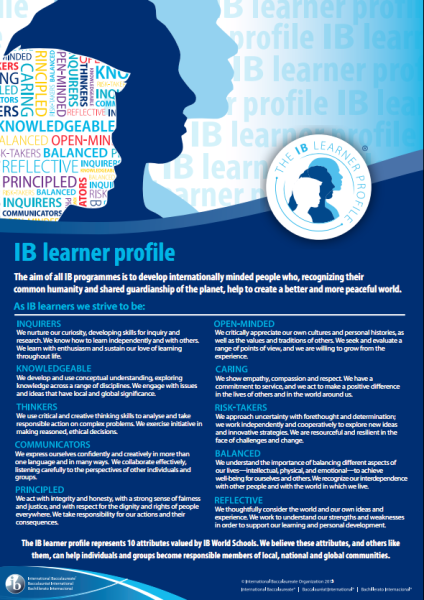
Furthermore, the DP is one usually offered in high schools around the world, for it is also the first program created and offered by the IB. While not all schools offer the IB program, if it is offered in one’s school, students aged 16-19 are eligible. Its principles are influenced by numerous past philosophers and educators, using their views on the world to shape the curriculum. For example, a core class that every student must take is Theory of Knowledge (TOK). The class is heavily inspired by multiple philosophers and educationalists and their views as stated in its description page. An important educationalist that helped inspire the IB to make their program was Alec Peterson. He was the first general director of the IB, and according to an article about his contributions, “He shaped the educational philosophy of the IB based on his own deeply humanist and liberal beliefs; from the IB’s commitment to stimulating courses, and its focus on independent research, to its balance between academic work and community service.” In this spirit, TOK is a course that promotes meaningful group discussions and use of critical thinking skills, within its projects, exhibition, and end-of-year 1,600 word essay.
Aside from TOK, philosophy is always a present subject in the programs and its classes. Per its description , the program strives to “develop students who have excellent breadth and depth of knowledge—students who flourish physically, intellectually, emotionally and ethically.” Wanting students to discover the views of others, the program helps them develop their original point of view of life, help build their philosophical voice, and promote deep thinking skills.
The DP is likely the program most students recognize out of the four and is the one students most likely are to join when they reach the grade to do so. As stated by Loudoun County Public Schools in a comparison chart with other higher level classes, to receive an IB diploma, one is required to take certain classes throughout their high school career. For example, beside the core class of TOK, one must take six courses in different subjects, and at least three higher-level classes and three standard-level classes. Students must also write a 4,000 word extended essay and must have completed 150 hours of creativity, activity and service (CAS) by the time they graduate. Completing the requirements for an IB Diploma also earns them the Advanced Diploma.
In the same chart, IB is compared to other advanced classes like Advanced Placement (AP) or Dual Enrollment (DE). AP consists of classes with college-level class work which give you a grade bump and may earn a student college credit. Similar to IB, it requires an end of year test in which one must pass to be able to collect their extra college credit. Likewise, DE also helps you earn college credit, but instead of testing, it consists of students dual-enrolling in both their high school and a partnering college. This lets DE students access college benefits such as access to colleges campuses or campus libraries. All classes are viewed similarly due to their higher level grade bump and rigorous class work. Some people may wonder what are the key differences in AP and IB and which one of the two might be better to take. The truth is that not one is more difficult or better to take than the other; rather, it all depends on the student, and what they are capable of in terms of challenging themselves. IB allows a student to challenge themselves while at the same time learning more about oneself through experiential learning. Due to its global recognition, it’s also a great option for those who may be interested in studying abroad with its numerous available exchange programs. On the other hand, AP or DE may be better for those who enjoy having flexible schedules and want to earn college credit while still challenging themselves since students are able to freely choose what classes they would like to take; also, it is possible to take IB classes without necessarily going for the full diploma.
In conclusion, whether you decide to take individual IB classes or enroll in the full DP, both will prepare you for college and future challenges in life. These opportunities encourage critical thinking and let students take ownership of what they’re learning. It’s always great to take risks for oneself in one’s studies and IB is a great way to do this.