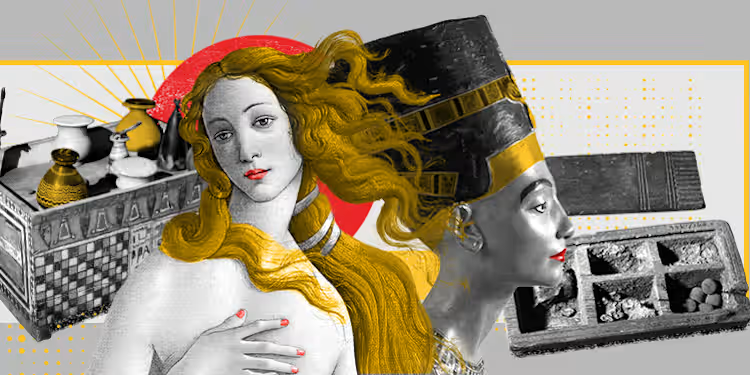
Nowadays, to some people, makeup may seem as a mask to cover up insecurities, but it wasn’t always that way. Beauty standards led and continues to lead women to change their looks in order to fit in. All time periods had their beauty standards. From covering faces in lead, to stuffing undergarments for a “healthy shape”, beauty standards are nothing less of a law that women feel compelled to follow. Women, throughout modern times, are supposed to look a way that was based on very specific characteristics, commonly established by men.
Starting thousands of years ago, women began to take extreme and even dangerous measures to look the way beauty standards said they should look. A woman with a fair skin complexion was labeled as being wealthy. Due to this, techniques referred to as skin whitening, or skin bleaching, which used lead to lighten the complexion, were used primarily in ancient Greece, Rome, and Asia. One primary cosmetic that was used was ceruse. Ceruse was made up of powdered white lead and vinegar. Ceruse was so incredibly dangerous that “it caused everything from tooth loss to mental decline” (Rotondi). Ceruse was used primarily to cover up scars or marks that were previously made from diseases, even though it was known that ceruse would cause worsening or even incurable diseases. Lead was not the only way to acquire the light, porcelain skin tone that many women desired. Other products that were used were “mercury-based skin-whitening cream, while in Victorian England, women were willing to ingest arsenic wafers to ‘remove all imperfections’ and achieve that deathly pallor” (Rotondi).
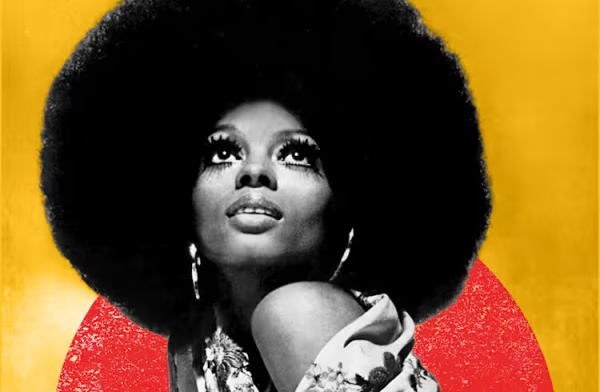
Hairstyles have been used throughout history to signify things such as wealth, health, and marriage status. In many countries, hair was and is something that was required by different cultures to be kept hidden. In ancient Rome, husbands were allowed to divorce their wives if they ever took off their head coverings in public. During medieval European times, married women kept their hair up, either braided or tied up to their heads with some sort of hat, veil or other covering. This was to show modesty, as well as marital status. Due to how much power it seems that hair holds, it was also used as rebellion or a way to protest. For example, during the time of civil rights, “the afro was a symbol of Black pride” (Rotondi). During the 1700s in medieval Europe, baldness began to be associated with being sick with syphilis because of the way that doctors treated patients with the disease. Doctors would use mercury in order to cure it, which was also the cause of the hair loss that many people struggled with. At this same time, it was believed that a full head of hair signaled manliness as well as health. Due to this, members of the government began to wear big, full wigs in order to show power.
Before plastic surgery, or cosmetic surgery, women would add padding to their skirts to create a fuller hip look, as well as wearing corsets in order to slim their waists. In ancient times, a healthy body was based off of the “Venus figurines”, which are statues that date back to over 25,000 years ago. These figurines define women’s bodies as pear shaped with large busts and stomachs. These statues became the norm for women because they showed signs of fertility. As the years progressed, the curvy body type continued to be the ideal body shape for women. Corsets were invented in order to enhance the curves, holding in a woman’s waist while her hips and bust were more prominent. “The corset was originally introduced in the early 1500s and quickly became popular among the French court” (Johnson). During the time of Queen Elizabeth I, pale skin matched with a bold red lip became popular, which signified a wealthy status.
During the 1920s, curvy bodies were out, and slender, slim figures were in. These people were known as flappers. As this look became more popular, eating disorders began to be more prominent. This was due to the reduced eating diet that many people followed in order to maintain the flapper figure. Along with the slim figure, flappers also commonly had short, boyish hair. The reason for the dramatic change from Victorian beauty standards was due to women gaining more rights in the US, as well as other countries in the world. During the 1930s, during the Great Depression, “women were held to much less of a beauty standard during this period since the US was in economic turmoil” (Johnson). During this time, the ideal body type became more round, due to people not wanting to look like they were poor and starving.
In the 1940s and 50s, a slender yet curvy body shape became popular due to models and actresses like Marilyn Monroe portraying these body types. In the 60s and 70s, the ideal body type went back to the thin body that many females had during the flapper era, which also brought back higher amounts of eating disorders. In the 80s, women were meant to be thin, yet strong and healthy. During the 80s, the body standards were extremely specific and narrow. In the 90s, skinny body types were back in fashion, again with the rise of eating disorders. In the 2000s, many people were confused as to how they should look. Because of the thin body types that many people had in the 90s, the slim figures led into the 2000s. In the 2010s and today, diverse body types were and are more welcomed due to the rise of social media, where people were exposed to more diverse body types than they’d previously seen. Although, despite being exposed to different body types, people still struggle with negative self-image.
All throughout history, women were told how to look in every possible way. It is only now that the world is starting to accept different body types. This is a positive indicator that the world is getting better at seeing beauty in all body types.
All photos credited to History.com.